
BakeryDiary is a recipe curation and editorial platform. We research and curate recipes from public sources, considering ratings, reviews, comments, and feedback. We then refine and present them clearly for home cooks. We are committed to an ad-free, focused experience that makes discovering and preparing recipes easier.
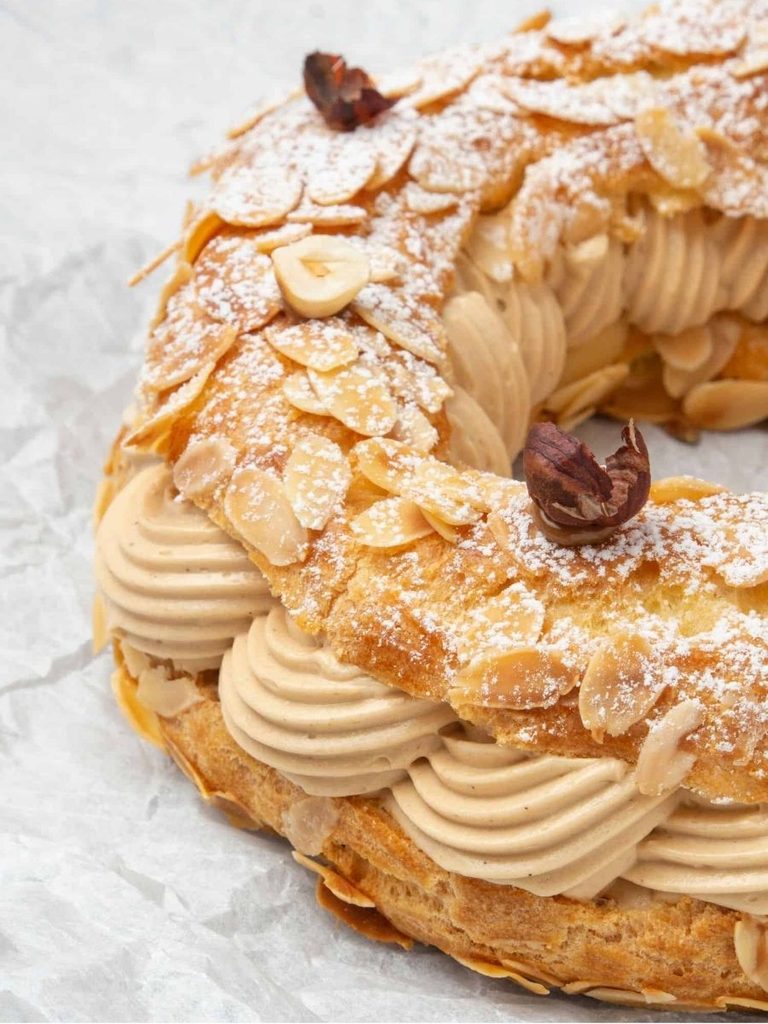
Paris-Brest is an impressive French pastry built around a crisp, beautifully puffed ring of pâte à choux and a luxurious hazelnut praline crème mousseline.
The choux shell is lightly crisp on the outside while remaining tender inside, creating the perfect contrast to the smooth, airy filling.
Hazelnut praline paste gives the crème mousseline its deep roasted-nut flavor, while whole milk, vanilla, egg yolks, butter, cornstarch, and flour create its rich pastry-cream base.
Roasted almond flakes add another layer of nuttiness and a delicate crunch to the baked choux.
Once assembled, the pastry is finished with powdered sugar, roasted hazelnuts, and hazelnut praline paste for an elegant presentation.
Although this recipe involves several stages and chilling periods, each step contributes to the final texture and structure, making Paris-Brest a rewarding centerpiece for special occasions or an ambitious home-baking project.


Golden Paris-Brest Rings with Silky Hazelnut Praline Cream
Ingredients
Equipment
Method
- Prepare the Flour and Piping Setup: Sift the bread flour and measure it accurately. Prepare a pastry bag fitted with a 0.5-inch (1.3 cm) Wilton 6B French star nozzle, and line a baking sheet with a perforated “air” baking mat or baking paper.
- Heat the Choux Base: Combine the butter, water, whole milk, salt, and sugar in a saucepan. Heat over medium heat, stirring occasionally, until the mixture reaches a simmer without allowing it to boil.
- Add the Flour: Remove the saucepan from the heat and immediately add all the sifted flour at once. Stir vigorously with a rubber spatula until a smooth, lump-free dough forms.
- Dry the Dough: Return the saucepan to medium heat and cook the dough for 3–5 minutes, stirring constantly. Continue until enough moisture has evaporated and a thin film begins to form on the bottom of the pan.
- Cool the Dough Slightly: Transfer the cooked dough to the bowl of a stand mixer fitted with the paddle attachment. Mix on low speed for about 1 minute to cool it slightly.
- Incorporate the Eggs: Lightly beat the room-temperature eggs, then add them gradually, one small spoonful at a time, while mixing. Let each addition become fully incorporated before adding more. Continue for about 2–3 minutes until the dough is glossy and pipeable.
- Check the Dough Consistency: Stop adding egg when the dough slowly falls from the paddle in a V shape. It should be thick enough to hold its shape rather than run. The precise amount of egg can vary according to the flour and how much moisture evaporated during cooking.
- Chill the Choux Dough: Transfer the dough to the prepared pastry bag and refrigerate it for 1 hour before piping.
- Pipe the Rings: Pipe two circles directly beside one another so the choux dough touches, then pipe a third ring over the top of the first two. For a finished ring measuring approximately 19 cm / 7.5 inches, pipe the circles at about 14 cm / 5.5 inches because they will expand during baking.
- Repeat the Piping: Repeat the three-ring piping process twice more so you have three Paris-Brest rings in total.
- Add the Almond Flakes: Sprinkle the roasted almond flakes evenly over the entire surface of the piped choux rings.
- Freeze the Piped Choux: Place the tray in the freezer for at least 1 hour before baking.
- Preheat the Oven: Preheat the oven to 200°C / 392°F with no fan.
- Bake the Choux Rings: Place the frozen rings in the oven and immediately reduce the temperature to 170°C / 338°F, keeping the oven on the no-fan setting. Bake for 40 minutes, and do not open the oven during the first 30 minutes.
- Check for Doneness: At 40 minutes, check one ring if this is your first time making the recipe. The choux should be golden, well puffed, and able to hold its shape at room temperature without deflating. The center should not remain raw; a slightly moist interior is acceptable because it will continue drying as it cools.
- Cool the Choux: Allow the baked rings to cool completely on a perforated air mat, or transfer them to a cooling rack if they were baked on parchment paper.
- Whisk the Egg Yolks and Sugar: Combine the egg yolks and granulated sugar in a bowl and whisk for 1–2 minutes until the mixture becomes fluffy.
- Add the Dry Ingredients: Whisk in the cornstarch, all-purpose flour, and vanilla extract until the mixture is smooth.
- Heat the Milk: Warm the whole milk in a saucepan until it just reaches a simmer. Do not let it boil.
- Temper the Egg Mixture: Slowly pour the hot milk into the egg yolk mixture while whisking continuously to gradually bring the yolks up to temperature.
- Cook the Pastry Cream: Return the tempered mixture to the saucepan and cook over medium heat, stirring constantly, until thickened. Once it reaches a boil, continue cooking for about 1 minute.
- Smooth the Cream: If the pastry cream develops lumps, continue whisking until smooth. Remove it from the heat and strain it if necessary.
- Add the Butter: Gradually incorporate the 57 g room-temperature butter in chunks, mixing until completely blended into the pastry cream.
- Cool the Pastry Cream: Transfer the pastry cream to a shallow bowl and cover its entire surface directly with plastic wrap to prevent a skin from forming. Allow it to cool completely before making the mousseline cream.
- Bring Ingredients to Room Temperature: Make sure the pastry cream and both the butter and hazelnut praline paste are at room temperature before combining them. Using ingredients at different temperatures can cause the cream to curdle.
- Whip the Butter: Place the 150 g room-temperature butter in the stand mixer and whip for 1–2 minutes until softened and aerated.
- Add the Praline Paste: Mix the hazelnut praline paste into the whipped butter until evenly combined.
- Incorporate the Pastry Cream: With the mixer running, add the room-temperature pastry cream in four stages. Allow each addition to fully incorporate before adding the next.
- Whip Until Fluffy: Continue mixing on medium speed until the crème mousseline becomes stable and fluffy. Avoid over-whipping, as the cream can become too soft and runny.
- Prepare the Piping Bag: Transfer the finished mousseline cream to a pastry bag fitted with a nozzle such as a Wilton 1M or French star tip.
- Chill if Necessary: If the cream feels too soft for piping, refrigerate it for 30–60 minutes. Do not chill it excessively, because the butter can become firm and make the cream difficult or impossible to pipe.
- Open the Choux Rings: Cut the top portion from each completely cooled choux ring.
- Add the Roasted Hazelnuts: Place about 1 tablespoon of chopped roasted hazelnuts inside each ring.
- Add the Praline: Drizzle some hazelnut praline paste over the chopped hazelnuts.
- Pipe the Mousseline: Pipe the hazelnut praline crème mousseline around the choux ring, creating an even layer of filling.
- Finish the Tops: Dust the cut tops of the choux rings with powdered sugar.
- Complete the Pastries: Place the powdered-sugar-dusted tops back onto the filled rings and decorate with additional hazelnuts and hazelnut skin.
- Serve Fresh: Serve the Paris-Brest immediately after filling for the best crisp texture. Once filled, the choux gradually loses its crispness. Leftovers can be refrigerated for about 1 day.
Notes
- Measure by weight: Use a digital scale for the most accurate results, especially for the choux pastry and pastry cream.
- Use high-protein flour: Bread flour with around 12–13% protein helps give the choux enough structure to puff properly.
- Start with room-temperature butter: This allows the butter to melt evenly with the water and milk during the initial heating stage.
- Do not skip sifting: Sift the flour before adding it to the hot liquid to help prevent lumps in the choux dough.
- Watch the egg quantity: The full 220 g may not always be necessary. Add the beaten eggs gradually and stop once the dough falls from the paddle in a slow V shape.
- Respect both chilling stages: Refrigerating the choux dough before piping and freezing the shaped rings before baking are both important for neat, well-formed pastries.
- Use the correct nozzle: A closed French star nozzle helps the Paris-Brest rings puff neatly. A round or open-star nozzle will not produce the same result.
- Avoid opening the oven early: Keep the oven door closed for the first 30 minutes of baking so the choux rings have time to establish their structure.
- Bake without the fan: The original recipe recommends a no-fan oven because fan-assisted baking can encourage cracks in the choux.
- Check your oven temperature: A digital oven thermometer is useful because household ovens can run hotter or cooler than their displayed temperature.
- Keep mousseline ingredients at room temperature: The pastry cream and butter should be at the same temperature when combined to reduce the risk of curdling.
- Do not over-whip the mousseline: Stop once the cream is stable and fluffy; excessive whipping can make it loose and runny.
- Fill just before serving: The choux gradually loses its crispness after being filled, so Paris-Brest is best enjoyed fresh.
Chef’s Secret
For the most reliable choux texture, treat the egg quantity as a consistency adjustment rather than automatically adding all 220 g.
Because flour type and moisture evaporation vary, add the lightly beaten egg gradually and stop as soon as the dough falls slowly from the paddle in a thick V shape.
This simple visual test is more dependable than relying solely on the measured egg weight.
Serving Suggestions
Serve the Paris-Brest shortly after filling so the contrast between the crisp choux, creamy hazelnut mousseline, and roasted nuts is at its best.
Finish each pastry with a light dusting of powdered sugar and a few additional roasted hazelnuts or pieces of hazelnut skin for an elegant presentation.
A little extra hazelnut praline paste can also be drizzled over the filling or plate for a stronger praline finish.
Because the pastry is already rich and nutty, simple presentation and restrained garnishing work particularly well.
Conclusion
Paris-Brest is an elegant French pastry that rewards careful technique with an impressive combination of textures and flavors.
Crisp, golden choux surrounds silky hazelnut praline crème mousseline, while roasted almonds and hazelnuts provide a delicate crunch.
With attention to dough consistency, chilling, baking, and cream temperature, this classic pastry makes a beautiful centerpiece for any special dessert table.
